Wellness • 25/5/2026
Pregnancy Yoga: What's Safe at Each Trimester (and What to Skip)
The poses to keep, the ones to modify, the ones to skip — by trimester. Plus birth-prep yoga, the breath work that matters, and how to spot a real prenatal class from a regular yoga class with a 'pregnancy-friendly' tag.
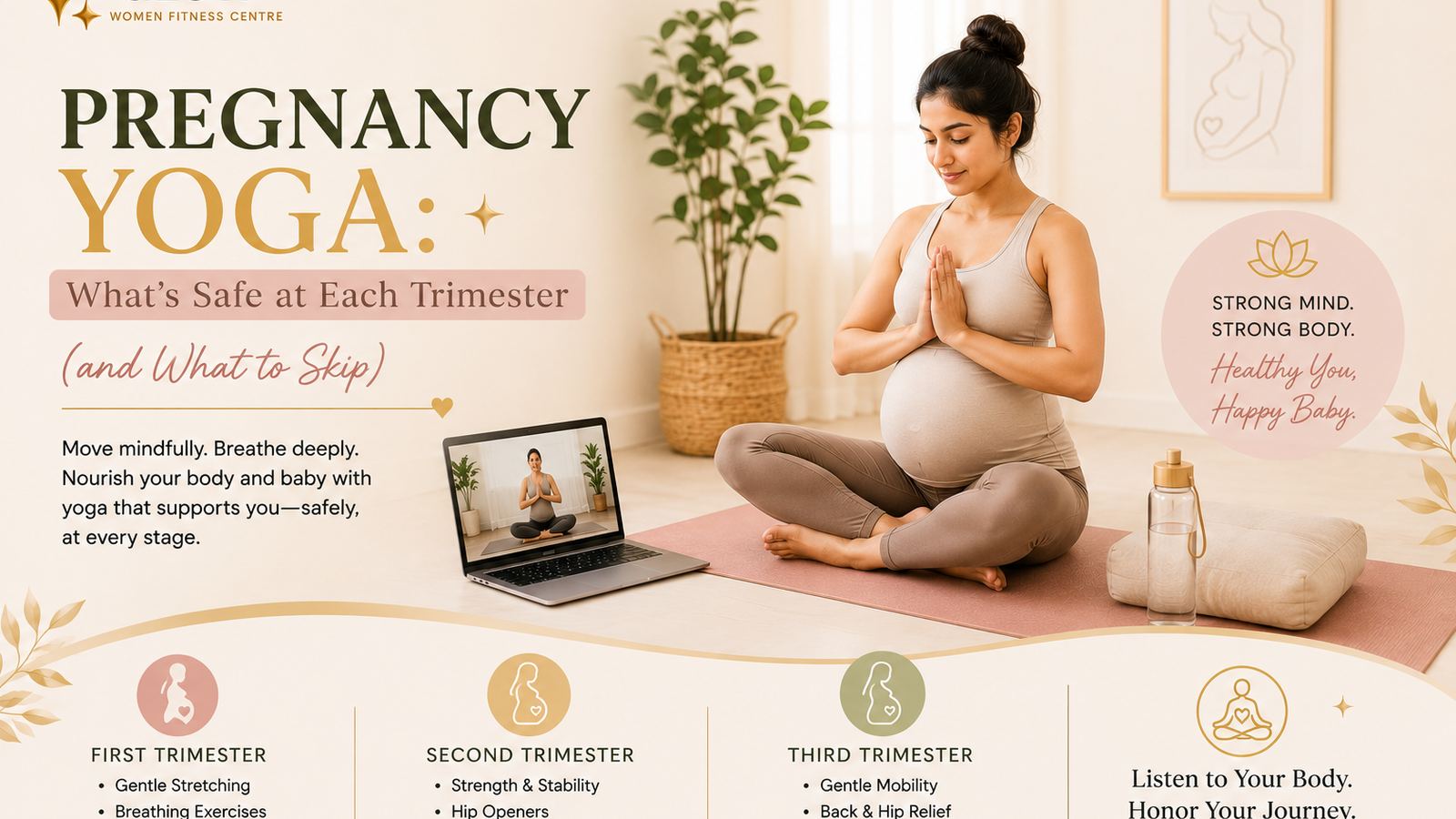
Pregnancy yoga is one of the most marketed and least standardised forms of fitness for women in India. Most “prenatal yoga” classes are regular yoga classes with a couple of modifications announced at the start. That’s not the same thing as a class designed around pregnancy biomechanics.
This is what actually matters — by trimester, with specific poses and what to skip.
What pregnancy yoga is for
Three goals, in order of importance:
- Keep the body comfortable through a 9-month transformation — relieving back pain, opening hips, easing sleep.
- Prepare for birth — squat strength, hip mobility, deep breath capacity, pelvic floor control (the squeeze and the release).
- Mental and emotional steadiness — pregnancy hormones swing wildly. Breath and gentle movement are evidence-based mood regulators.
What it’s NOT for:
- Weight management
- “Toning”
- Performance — this is not the season for personal records
If a prenatal class is marketing weight loss or “staying in shape”, be skeptical.
Why the trimester matters so much
The pregnant body is biomechanically different at week 8 vs week 18 vs week 32. Same body, different shape, different ligament laxity, different organ position. A pose that’s perfect in T1 can compress the vena cava in T2 and crush your lungs in T3.
A real prenatal yoga class adjusts every pose to the trimester of every member in the room. A recorded “prenatal yoga” video usually doesn’t.
First trimester (weeks 5–13)
What’s happening: fatigue and nausea dominate for many. Bump invisible. Relaxin (the ligament-loosening hormone) is starting to rise — joints feel a bit different.
Safe poses to lean into
- Cat-cow (Marjaryasana) — daily. The single best pose for early back relief and gentle spinal mobility.
- Child’s pose with knees wide — restful, opens hips, easy on a queasy stomach.
- Standing forward fold (modified) — feet wider than hip-width, slight bend in knees, head dropped. Releases the back.
- Goddess pose (Utkata Konasana) — wide squat, very gentle hold. Birth-prep foundation work.
- Diaphragmatic breath practice — 5 minutes, daily. Hand on belly, slow inhale → belly rises, long exhale → belly falls. Foundation for everything.
What to skip immediately
- Hot yoga — overheating raises baby’s body temperature; especially important in T1 for organ development
- Deep twists (revolved triangle, deep seated twists) — compress the abdomen
- Inversions (headstand, handstand) unless you’re already a seasoned practitioner who has discussed with your OB
- Strong abdominal work (boat pose, traditional crunches)
- Holding breath under load (the “bandhas”-heavy ashtanga style needs major modification)
What’s hard to predict
Nausea: yoga either helps or makes it worse, and you’ll only know by trying. If it helps, the simple flows above are your medicine. If it makes you queasier, skip to just walking and breath work for a few weeks until nausea passes.
Second trimester (weeks 14–27)
What’s happening: the “best” trimester for most women. Energy returns, nausea eases, bump visible. This is when most pregnant women can actually train productively — not just survive.
Safe poses (this is the peak training trimester)
- Wide-stance squats — held for 30 seconds, repeated 3–5 times. Best single birth-prep pose.
- Goddess flow — squat → step out → squat → step out. Mobility + strength.
- Hip openers — pigeon (knees down, supported with cushion), butterfly, low lunges
- Cat-cow and table-top variations — bird-dog modified for bump, knee-to-elbow stretches
- Standing balance poses — tree, modified warrior 3 (against a wall) — challenge the pelvic floor and proprioception
- Side-lying twists — get the spinal mobility without the compression
- Supported side-bends — relieves rib-stretch discomfort
- Bridge pose (held briefly, with knees slightly apart) — pelvic floor + glute activation
Modifications that matter at this point
- No flat-on-back work for more than a few minutes — vena cava compression. Use an incline (yoga bolster propped against a wall).
- No deep twists — keep all twists open, away from the bump
- Wider stance everywhere — feet wider in squats, hands wider in down-dog, knees wider in child’s pose
Pelvic floor work doubles in importance now
The floor is supporting a growing baby. Your daily routine should be:
- 10 elevator kegels (slow lift × 5 second hold × slow release)
- 10 quick flicks
- 5 reverse kegels (the release practice — this becomes critical for birth)
Don’t skip the reverse kegels. A locked pelvic floor doesn’t birth well.
Third trimester (weeks 28–40)
What’s happening: bump is heavy, sleep is harder, baby is rapidly gaining weight. Energy varies day to day.
Safe poses
- Supported squats — back against a wall, sliding down to 90 degrees, holding 20–30 seconds. Direct birth prep.
- Cat-cow — daily. Eases the back and creates space for baby to position well.
- Child’s pose with knees wide — possibly the most-used pose of this trimester.
- Standing forward fold (very modified) — feet wide, hands on a chair, hip-hinge to a comfortable depth
- Hip-opener stretches — pigeon (modified, deeply supported), butterfly with bolster
- Side-lying everything — savasana, gentle stretches, breath work
- Birth-rehearsal squats — deep squat hold while practicing your labour breathing pattern (slow inhale, very long slow exhale)
- Perineal stretching (week 34+, with OB clearance) — manual perineal massage is well-evidenced for reducing tearing
What to skip in T3
- Any back-lying poses for more than 1–2 minutes
- Deep twists, deep backbends
- Anything that causes pelvic pressure or breathlessness
- New, intense practices you haven’t done before
- Pose holds longer than what’s comfortable (joints are more lax — easier to over-stretch and injure)
The breath practice that matters most
In your daily yoga in T3, spend at least 5 minutes practicing your labour breath pattern:
- Slow inhale (4 counts)
- Very long, slow exhale (8 counts, longer if you can)
- Repeat for 5 minutes
This becomes muscle memory. In active labour, your breath is the difference between bracing through contractions (painful, slow) and breathing through them (still hard, but manageable). The earlier you’ve made this automatic, the better birth tends to go.
What to skip entirely throughout pregnancy
These come up enough that they’re worth listing as a no-list:
- Hot yoga or yoga in a hot room — entire pregnancy
- Prone (face-down) poses — once bump is visible, ~week 12
- Deep twists — once bump is visible
- Headstands, handstands, inversions — unless seasoned and cleared by OB
- Bandhas (the contraction locks of ashtanga) — modify or skip
- Breath retention practices (kumbhaka) — skip
- Anything that causes the belly to “cone” or dome — sign of intra-abdominal pressure too high
- Sit-ups, crunches, boat pose — anytime in pregnancy
How to spot a real prenatal class from a “modified yoga” class
A genuine prenatal yoga class:
- The teacher asks your trimester at the start
- They modify every pose for you individually (not just one announcement at the start)
- The class itself is structured differently — no flow sequences that go from inversion to floor to standing rapidly
- Pelvic floor work is in there, multiple times
- Breath work takes up real time, not just a closing minute
If a class doesn’t do these things, it’s a regular yoga class with a label.
Live vs recorded prenatal yoga
For prenatal specifically, live wins by a wider margin than for general fitness. The reasons:
- Modifications need to be specific to your trimester and how your bump sits — a recorded video can’t see you
- You’re more likely to skip a pose you’re unsure about — a live instructor cues you to do the modification rather than nothing
- Your pelvic floor work needs feedback (“am I doing this right?”) — only a live coach gives that
- Pregnancy is emotionally intense; the community of a live class with other pregnant women matters in a way recordings don’t replicate
The Glow approach
Our Pre-Natal Fitness program runs trimester-aware prenatal yoga as part of the weekly rotation. Coaches scale every pose to the trimester of each member.
Use the Pregnancy Fitness Guide tool to see your current week’s safe-exercise list, pelvic-floor work, birth-prep moves and warning signs.
A dedicated Online Pre-Natal program is on our roadmap. In the meantime, women outside Tiruchengode can join the general Online Everyday Glow classes — let your coach know you’re pregnant and they’ll modify in real time.
The short version
- Trimester matters more than yoga style. A pose safe in T1 may be unsafe in T2.
- T1: cat-cow + breath work foundation. Avoid hot yoga, inversions, deep twists.
- T2: peak training trimester — wide squats, hip openers, pelvic floor. No back-lying for long.
- T3: comfort + birth prep. Squat holds + breath patterns. Avoid back-lying and deep stretches.
- Pelvic floor work scales up across pregnancy — and the release matters as much as the squeeze.
- A real prenatal class modifies per pregnant woman in the room, not via one announcement.
Use the Pregnancy Fitness Guide tool → · See the Pre-Natal Program →