Wellness • 25/5/2026
Period Workouts: What to Do During Your Cycle (and What to Skip)
Working out on your period isn't off-limits — it just needs to look different. What to do on day 1 vs day 3, when gentle movement beats rest, when to honour the rest day. A coach's honest take.
Two camps. One says “never train on your period — let your body rest.” The other says “push through, you’re stronger than you think.” Both are wrong.
The body has clear, predictable shifts across the menstrual cycle. The right approach during your period isn’t more or less effort — it’s different effort. Here’s what actually works.
What’s actually happening biologically
Day 1 of your cycle is the first day of bleeding. Hormonally, this is when:
- Oestrogen and progesterone are at their lowest (they crashed in the few days before bleeding starts — which is also why PMS hits then)
- Pain tolerance can actually be higher for many women (paradoxically, the low-hormone state may help)
- Energy levels vary a lot between women — some are wrecked, some feel surprisingly clear-headed
- Mood often lifts by day 2 or 3 as the body finishes the heaviest bleeding phase
The most important thing to understand: there’s no single “period experience”. A woman with light, painless 3-day periods can train almost normally. A woman with heavy, painful 6-day periods needs a different approach. Both are normal.
Should you exercise during your period?
For most women: yes, and it helps. Movement during your period — even gentle movement — reduces cramps, lifts mood, eases bloating, and shortens the bleeding phase for many. The medical evidence is consistent: women who keep moving during their periods report fewer symptoms than women who stop completely.
The exception: severe dysmenorrhoea (heavy painful periods), endometriosis flares, or unusually heavy bleeding. These are signals to scale way back — and if recurring, signals to talk to a gynaecologist.
A 5-day period workout plan
For a typical period, this is the structure that works for most women:
Day 1: The hardest day — gentle only
What to do:
- A short walk (15–20 min, outdoors if possible)
- Restorative yoga (child’s pose, supine twist, legs-up-the-wall, supported butterfly) — 20–30 min
- 5 minutes of slow breath work (long exhales calm the nervous system, often softens cramps)
What to skip:
- PRs, heavy lifts, sprints, HIIT — they don’t work well biomechanically when your core is bracing differently around cramps
- Anything that requires holding your breath under load
- New skills or movements you haven’t done before
The instinct to just lie down is real — and a rest day is fine. But for most women, 20 minutes of gentle yoga and a walk beats a full day of lying around.
Day 2: Bleeding eases — gentle progression
What to do:
- Light strength work — bodyweight squats, glute bridges, wall push-ups, dead-bugs. 2 sets of 10–12. Skip overhead presses if you have lower-back cramping.
- A 30-minute walk
- Gentle yoga to close the day
You’re not training for PRs — you’re keeping the blood flowing and the body familiar with movement.
Day 3: Most women feel the shift here
By day 3, oestrogen is starting its climb. Cramps are often easing. Mood often lifts.
What to do:
- Strength training as normal — but maybe at 80% of your usual load
- Moderate cardio if you feel like it — dance, brisk walk, light cycling
- Stretch + breath work at the end
This is when most women realise they actually feel better than they expected. Trust that.
Day 4–5: Almost back to baseline
What to do:
- Full strength session at normal loads
- Cardio classes if your schedule has them
- Save the hardest, heaviest session of the week for next week (your follicular phase, days 6–12) — that’s your real peak
The cramp-management toolkit
Things that actually help with period cramps (evidence-based):
- Heat: hot water bottle, warm bath. The most reliable cramp reliever.
- Movement: especially gentle yoga and walking. Counter-intuitive but well-studied.
- Breath work: long slow exhales (4 in, 8 out for 5 minutes) calm the autonomic nervous system, often reducing pain.
- Magnesium: glycinate form, 200–400 mg before bed, often eases cramps the next month if taken consistently.
- Omega-3: 1–2 g EPA+DHA daily for 2–3 months reduces cramp severity for many women.
- Anti-inflammatory diet: more fish, leafy greens, turmeric, ginger; less refined sugar and seed oils.
Things that get marketed but don’t really help:
- Ice / cold packs (gentle counter-stimulation at best)
- “Detox teas” (placebo at best, diuretics at worst)
- Just-paracetamol without addressing the root (a band-aid)
When to skip the workout entirely
It’s not weakness to skip a session. Skip when:
- You’re soaking through pads/cups faster than every 2 hours (see a doctor)
- Cramps are severe enough that movement intensifies them (rest day, heat, breath)
- You feel lightheaded or unusually fatigued (could be low iron — get tested)
- Sleep was under 5 hours the night before (recovery is more important than the session)
If period symptoms are severely disrupting your life every cycle — heavy bleeding, debilitating pain, missed work or school — that’s not normal and not “just how periods are.” Endometriosis, fibroids, and adenomyosis are common, under-diagnosed, and treatable. See a gynaecologist.
The bigger picture — train across the whole cycle
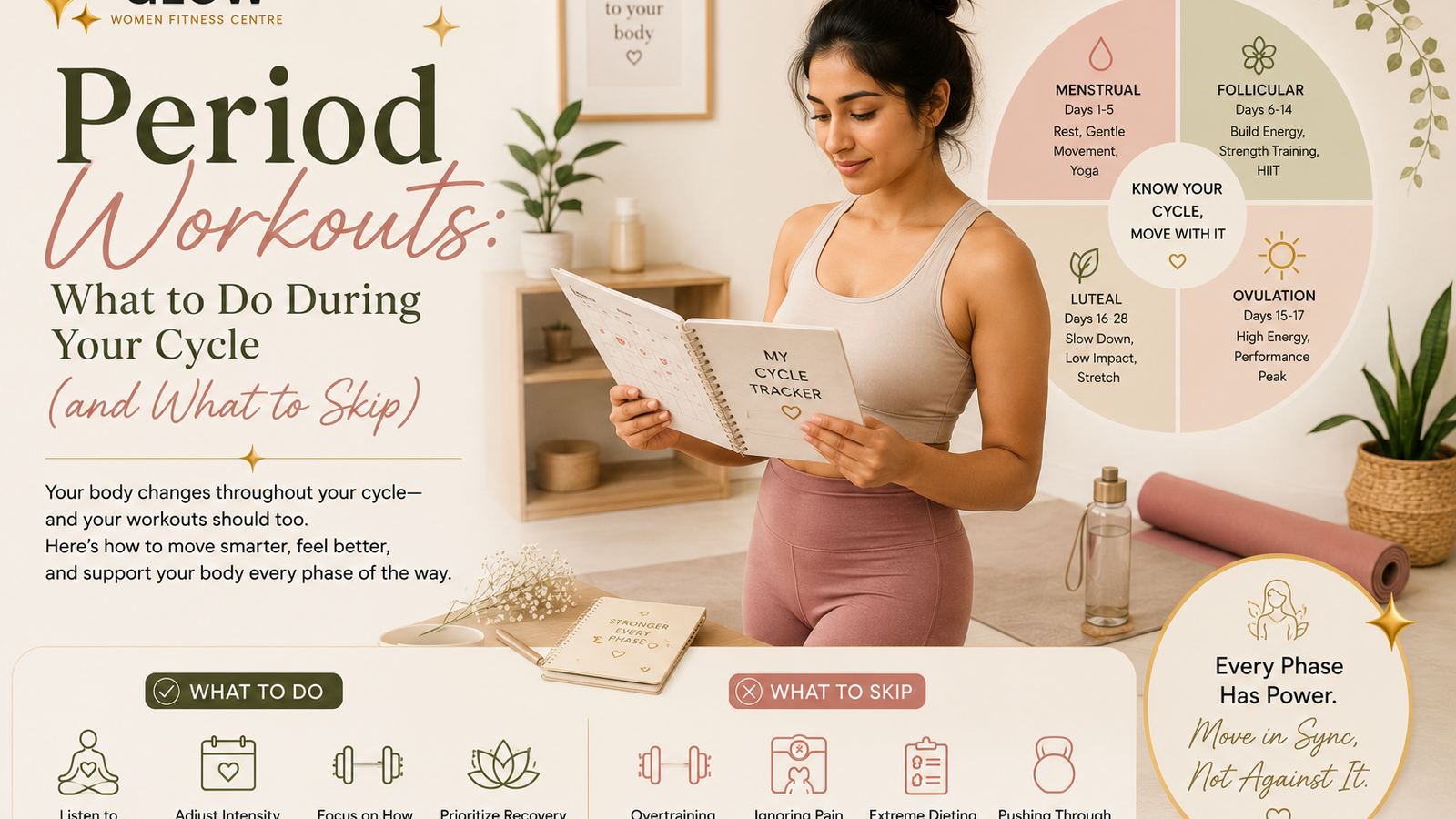
The right answer to “what should I do on my period” can’t be separated from what you do the rest of the month. The cycle has four phases — each with a different hormonal terrain:
- Menstrual (days 1–5): low oestrogen and progesterone. Gentle movement.
- Follicular (days 6 to ~12): rising oestrogen. Energy returns. Best time to push intensity and learn new movements.
- Ovulatory (~days 13–16): oestrogen peaks. Peak strength + social energy. Heaviest lifts.
- Luteal (days 17–28): progesterone rises, oestrogen drops. Early luteal still strong, late luteal (PMS week) needs to dial back.
Training with this rhythm — going hard when your hormones support it, easing when they don’t — produces better results and less burnout than treating every week the same. Our Cycle Fitness Planner tool maps your specific cycle.
What about irregular cycles?
If you have PCOS or post-pill cycles or irregular periods for any reason, the day-of-cycle approach is harder to follow. The workaround: track symptoms instead of dates. Higher-energy stretches = follicular-style training. Wind-down stretches = luteal-style. Bleeding days = menstrual-style.
For women with PCOS specifically, see our PCOS Self-Assessment.
Foods to lean into during your period
- Iron-rich: rajma, palak, beetroot, eggs, paneer, jaggery — replenish what you’re losing in blood
- Vitamin C alongside iron: lemon over dal, amla, citrus — doubles iron absorption
- Warm fluids: turmeric milk, ginger tea, jeera water — surprisingly settling
- Magnesium-rich: dark chocolate (yes, the craving is biochemistry), pumpkin seeds, almonds
Avoid or limit:
- Excess caffeine (worsens breast tenderness and cramps)
- Cold drinks and ice cream (for many women, intensifies cramps)
- Heavy alcohol (worsens PMS and bloating)
- Highly processed sugar (blood sugar swings = mood swings)
The Glow approach
Our Online Everyday Glow program is designed with cycle awareness — coaches scale sessions for members who indicate they’re on their period or in early luteal. Strength happens on the days your body supports it; recovery happens on the days it doesn’t.
Map your cycle with our Cycle Fitness Planner tool to see today’s phase + a phase-specific workout plan.
The short version
- Yes, you can (and probably should) move during your period.
- Day 1: gentle yoga and walking only.
- Day 2–3: light strength returns.
- Day 4–5: most things back on the table.
- Skip PRs and heavy lifts during bleeding — save them for your follicular phase (week after).
- Heat + breath + magnesium are your best cramp-management tools.
- Severe period symptoms are not normal — see a gynaecologist.
Train with cycle-aware programming → · Map your current phase →