
Workouts • 26/5/2026
How to Lose Belly Fat as a Woman (Without the BS)
You can't spot-reduce. Crunches don't work. Sweat belts are a scam. Here's what actually moves belly fat in women — the hormonal angle, the training, the food, and a realistic 12-week plan.
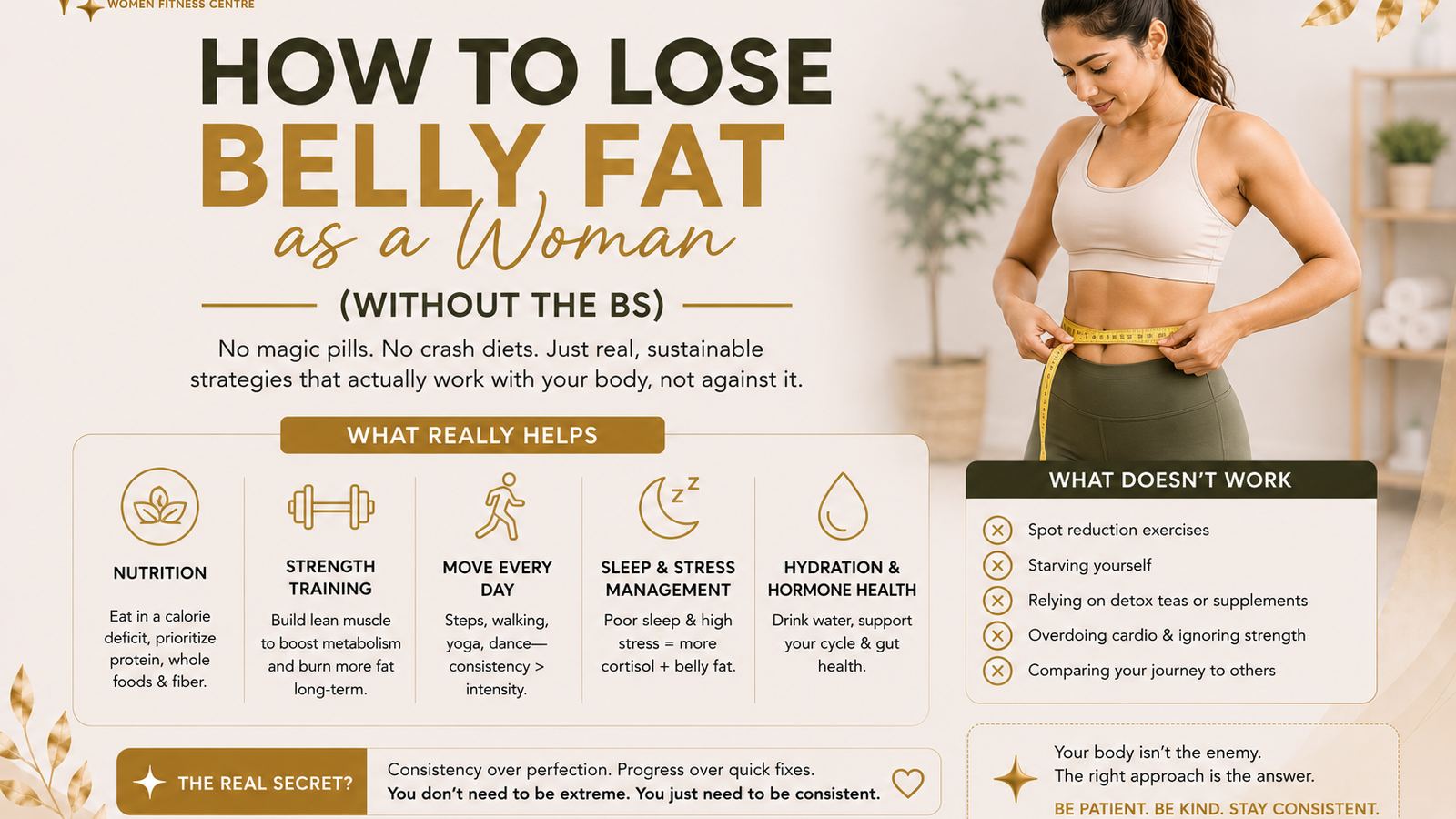
“How to lose belly fat” is the most-searched fitness query by Indian women, by a long way. It’s also the query most fitness marketing exploits — with sweat belts, “fat-burning” teas, “ab-blaster” plans and Instagram before/afters.
The honest version is less exciting and far more effective. Here’s what actually works.
The hard truth: you can’t spot-reduce
The single most important thing to understand: you cannot choose where you lose fat from. Your body decides. Doing 1,000 crunches does not preferentially burn belly fat — it builds the abdominal muscles underneath the fat, which you still can’t see because the fat is still there.
Fat loss happens systemically, in a sequence largely set by genetics and hormones. For most women, belly fat is among the last to go — particularly for women carrying weight around the abdomen (vs. hips, thighs, or upper body).
The good news: if you’re consistent for long enough, belly fat does go. Just not in the order or timeline anyone selling you a product would prefer.
Why women’s belly fat is different
Two types of belly fat sit under your skin:
1. Subcutaneous fat — the pinchable layer just under the skin. This is mostly cosmetic and metabolically inactive.
2. Visceral fat — the deeper fat wrapped around your organs (liver, intestines, pancreas). This is the dangerous one. It produces inflammatory signals, drives insulin resistance, and is the type linked to metabolic disease.
Two facts to know:
- Visceral fat responds first to lifestyle changes. Your waist circumference often drops before the scale moves. That’s the visceral fat going.
- Three things drive belly fat accumulation specifically in women: chronically high cortisol (stress), chronically high insulin (refined carbs + low muscle), and dropping oestrogen (perimenopause and menopause).
What actually moves belly fat
In order of effectiveness — which is roughly the opposite of how fitness marketing tells you:
1. Strength training (the highest-leverage intervention)
Building muscle is the most underrated belly-fat strategy. More muscle = lower fasting insulin = less abdominal fat storage. Strength training also raises your resting metabolic rate, which compounds over months.
The protocol: 3 strength sessions a week, 30–40 minutes each. Compound movements (squats, hinges, push, pull). Lift heavy enough that the last 2–3 reps are hard.
This is the single biggest lever. Skip it and you’re optimising for the low-impact stuff.
2. Sleep (the under-rated fat-loss tool)
Chronic sleep deprivation (under 6 hours) has been shown to specifically increase belly fat storage. Cortisol rises with sleep loss; cortisol drives visceral fat.
If you sleep 5 hours and train 5 hours a week, you’ll lose less belly fat than someone who sleeps 7 hours and trains 3 hours a week. Sleep is doing the work too.
Aim for 7–8 hours. Magnesium glycinate (consult your doctor) often helps.
3. Walking — especially after meals
A 15–30 minute walk within an hour of meals blunts the post-meal glucose spike by 30–40%. Multiple walks across the day add up to real insulin-sensitivity gains — and lower insulin = less belly fat storage over time.
Aim for 8,000 daily steps + a deliberate post-dinner walk most evenings. This single habit moves belly fat for women whose schedule won’t accommodate more “workout.”
4. Protein-led eating
Most Indian women are eating roughly half the protein they need (see our protein guide for specifics). High protein has three direct effects on belly fat:
- Higher protein during weight loss preserves muscle (which keeps metabolism high)
- Protein has the highest thermic effect of any macronutrient (you burn more calories digesting it)
- Protein controls hunger and stabilises blood sugar → less snacking, lower insulin
Target: 1.6–2.0 g protein per kg of body weight per day, evenly across meals.
5. A modest, sustainable calorie deficit
Not severe. Not skipping meals. Not 800-calorie days. Those backfire badly for women — cortisol spikes, metabolism drops, period stops, and the weight (especially belly weight) comes back faster.
A 300–500 calorie/day deficit is the sweet spot. Use the calorie calculator to find your number.
6. Stress management (yes, really)
Chronic stress = chronic cortisol = belly fat. This isn’t woo-woo — it’s well-documented endocrinology.
The most-evidence-based stress-reducing practices:
- 10 minutes of breath work daily (long exhales)
- A daily walk outdoors (sunlight + movement compounds)
- Strength training itself (paradoxically — moderate-intensity strength training lowers chronic cortisol)
- Yoga 1–2× a week
If your life is genuinely high-stress and nothing in this list is moving the needle, that’s the conversation to have with a doctor and possibly a therapist. Belly fat that won’t move despite everything else is sometimes a cortisol signal.
What does NOT work
The marketing-heavy approaches that don’t deliver:
- Ab exercises alone — crunches, sit-ups, plank challenges. Build the muscle under the fat; don’t burn the fat.
- Spot-reduction creams, oils, massages — do nothing.
- Sweat belts, waist trainers, neoprene wraps — make you sweat water (which you’ll drink back), restrict the diaphragm (bad), and may compress internal organs (also bad). Not just useless — actively harmful for proper core function.
- “Detox teas”, fat-burner supplements — placebo at best, diuretics at worst. Most contain little more than caffeine and laxatives.
- Extreme low-calorie diets (under 1,200 kcal) — cortisol surge, metabolism drops, muscle loss, and the belly fat often goes up over 6 months as your body becomes more efficient at storing every calorie.
- Hours of cardio every day — see “stress / cortisol” above. Modest cardio is great. Daily 90-minute cardio is counter-productive for most women.
- “15-day fat loss challenges” — what comes off in 15 days is mostly water. The actual fat loss is barely beginning.
A realistic 12-week plan
For a woman with average weight gain who wants belly-fat reduction:
Weeks 1–4: Foundation
- 3 strength sessions a week, 30 min each (bodyweight + 2–3 kg dumbbells)
- 30-minute walk daily, ideally one post-dinner
- Add protein to breakfast (2 eggs + curd, or paneer paratha + curd, etc.)
- Sleep 7+ hours (if not, fix sleep before anything else)
- No calorie restriction yet — let the body learn the new pattern first
Expected: scale flat or slightly up (muscle gaining, fat starting to drop). Energy noticeably better.
Weeks 5–8: Add the deficit
- 3 strength sessions (adding weight as it feels easy)
- 2 short HIIT sessions a week (10–15 minutes — sprints, intervals)
- Daily walks + 1 long walk (45–60 min) on the weekend
- Hit your protein target (use the calorie calculator)
- Modest 300-cal deficit below your maintenance
- Sleep 7+ hours, manage stress
Expected: 1–3 kg down. Waist circumference visibly shrinking. Clothes looser around the middle.
Weeks 9–12: Compound the work
- 3 strength sessions (now meaningful weights)
- 2 HIIT + 1 yoga session
- Walks daily
- Continue 300–500 cal deficit, recalculated based on new weight
- Track waist weekly (single most useful metric — better than the scale)
Expected: 4–8 kg down. Visible belly-fat reduction. Real strength gains. The habits feel automatic — you’ve stopped relying on willpower.
For specific situations
PCOS belly fat
PCOS makes belly fat harder to lose because of insulin resistance — that’s why most diets fail. The fix: heavier emphasis on strength, post-meal walks, sleep, and inositol supplementation (consult your doctor). See our PCOS and weight loss guide for the full protocol, and take the PCOS Self-Assessment to find your dominant symptom cluster.
Post-pregnancy belly
The first thing isn’t fat loss — it’s checking for diastasis recti (abdominal separation, which 60% of postpartum women have). Crunches over a diastasis make it worse. See our Postpartum Readiness tool for the self-check + a structured timeline.
After ruling out diastasis (or once it’s mostly closed), the same 12-week plan above works — but build slower in months 1–6 postpartum.
Menopause / perimenopause belly
The hormonal shift around menopause (oestrogen drop) causes fat redistribution toward the abdomen — even without weight gain. The same plan works, with three additions:
- More strength — muscle loss accelerates around menopause, so resistance training matters more
- More sleep priority — perimenopause disrupts sleep; protect it aggressively
- Talk to your doctor about HRT — well-studied, often dramatic improvement in body composition + symptoms
How to measure progress
Stop weighing daily. Weight is noisy at the daily scale and meaningless without context.
What to track instead:
- Waist circumference weekly — best single measure of visceral fat
- One progress photo monthly (same outfit, same lighting, same time of day)
- Strength benchmarks (your goblet squat weight, your push-up count, your dumbbell row weight)
- How clothes fit
- Energy + sleep + mood (qualitative but real)
Belly fat changes show up in these before they show up on the scale. Trust them.
The Glow approach
Our Weight Loss Program and Online Everyday Glow classes are built around exactly this framework — strength-led, low-cortisol training, protein-first nutrition guidance, gradual progress.
For your specific calorie and macro target, use the calorie calculator.
The short version
- You cannot spot-reduce. Belly fat goes when overall body fat goes.
- The hierarchy of what moves belly fat: strength training > sleep > walks > protein > modest deficit > stress management.
- Crunches, sweat belts, detox teas, severe diets — none of these work, several actively backfire.
- 12-week plan: build foundation (1–4), add deficit (5–8), compound (9–12).
- Waist circumference + progress photos + strength benchmarks beat the scale.
- Special situations (PCOS, postpartum, menopause) need adapted plans.