PCOS • 24/5/2026
PCOS and Weight Loss: Why Most Diets Fail (and What Actually Works)
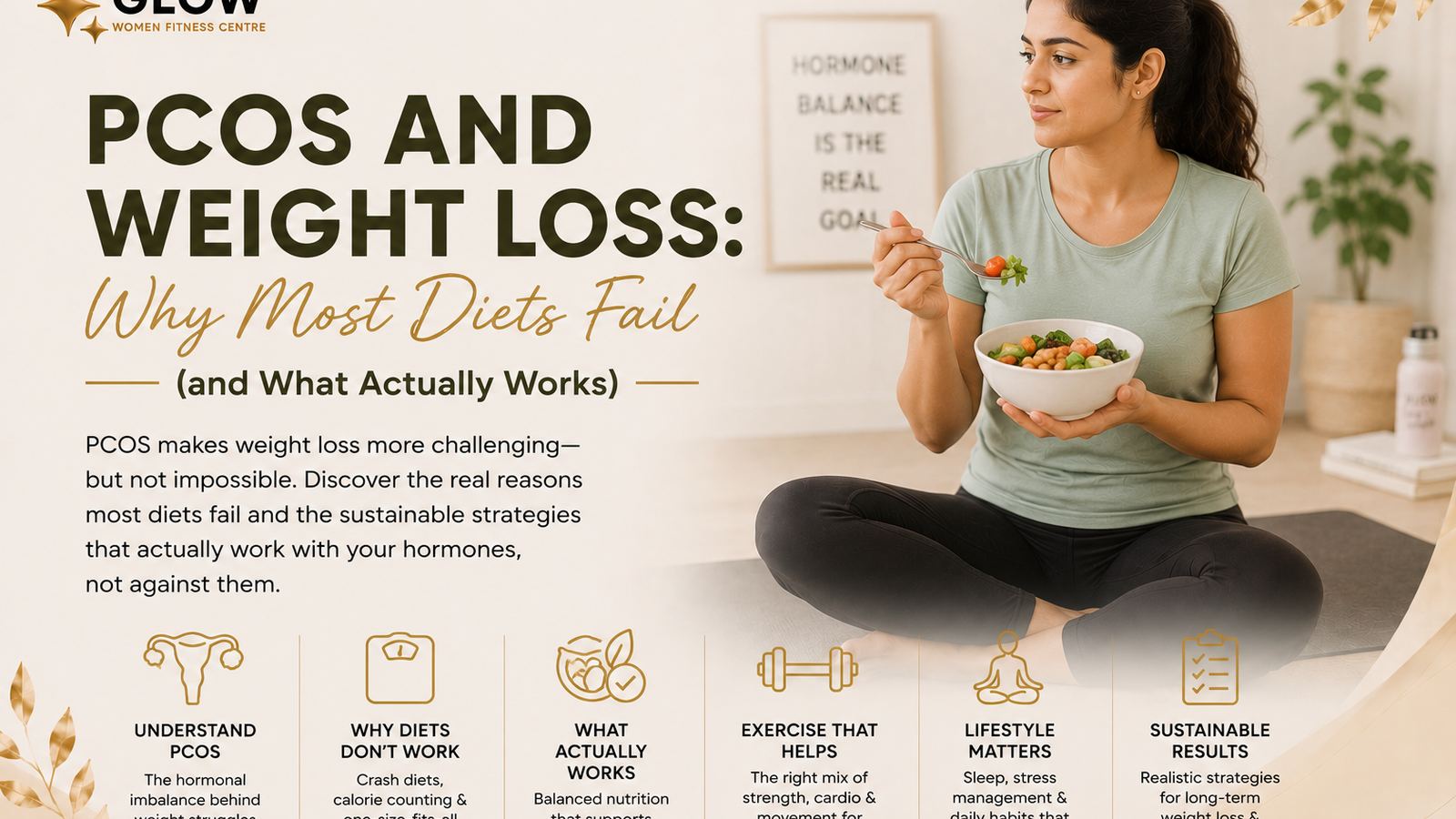
PCOS makes weight loss harder — but not for the reasons most diet plans assume. Why under-eating backfires, why chronic cardio makes you heavier, and the strength-led approach that works on a timeline of months.
If you have PCOS and you’ve tried to lose weight more than once, you’ve probably noticed: the standard advice — eat less, move more — works much worse for you than it does for your friends without PCOS.
You’re not imagining it. The biology is different. So the approach has to be different.
This is what actually works.
Why PCOS makes weight loss harder
Two mechanisms make standard weight-loss approaches less effective in PCOS:
1. Insulin resistance. Up to 70% of women with PCOS have insulin resistance — even at normal weight. High insulin signals your body to store fat, especially around the abdomen, and makes it harder to release fat for energy. The same calorie deficit produces less weight loss in an insulin-resistant body.
2. A different stress response. Women with PCOS often have a more reactive cortisol system. Chronic cardio, severe calorie restriction, and under-eating all spike cortisol — which raises insulin, which worsens androgens. The standard “eat less, do more cardio” advice can paradoxically make PCOS louder and weight loss harder.
These two facts explain almost every failed weight loss attempt in PCOS. The good news: once you stop fighting your body and start working with it, weight comes off — slower than for non-PCOS friends, but steadily.
The 3 mistakes most women with PCOS make
Mistake 1: Severe calorie restriction (under 1,200 kcal)
The body reads severe restriction as famine and responds by lowering metabolism, raising cortisol, and intensifying hunger. For PCOS this is doubly bad — cortisol drives insulin drives androgens. Women with PCOS who chronically under-eat often gain weight in the long run as their bodies become more efficient at storing every calorie.
The fix: a modest deficit (300–500 kcal below maintenance) that lets the body lose fat without going into stress mode. Use the calorie calculator to find your number.
Mistake 2: Hours of cardio every week
Long, chronic, daily cardio — especially fasted — pushes cortisol up. For most women this still produces some weight loss because they’re burning calories. For women with PCOS, the cortisol-insulin-androgen loop often cancels out the calorie burn.
Worse: chronic cardio breaks down muscle alongside fat, which lowers your resting metabolic rate further. Six months later you’ve lost weight but your body composition is worse, not better, and the weight regains as soon as you stop the cardio routine.
The fix: a small amount of intense cardio (1–2 short sessions a week), lots of walking, and the rest of your training as strength.
Mistake 3: Severe carb restriction (and giving up entirely after 2 weeks)
Keto and very-low-carb diets show short-term promise for PCOS (because they crash insulin). But for most Indian women they’re nearly impossible to sustain — our food culture is built on rice, roti, dal, idli, dosa. The 2-week dramatic weight loss is followed by the inevitable real-life resumption of carbs, and the weight returns plus interest.
The fix: don’t eliminate carbs — upgrade them. Swap white rice for hand-pounded or brown rice, maida for millets and atta, sugary breakfasts for protein-led ones. Pair every carb with fibre and protein. Slow-acting carbs in moderate amounts don’t spike insulin — and they’re sustainable for life.
What actually works for PCOS weight loss
The strategy in one paragraph: strength training 3× a week, protein at every meal, walks within an hour of meals, real sleep, and a modest calorie deficit. Hold this for 12+ weeks. Don’t expect dramatic week-by-week scale drops — expect a steady downward trend over months, with the bigger changes (waist, energy, mood, cycle) often showing up before the scale moves.
Here’s the detail:
Pillar 1: Strength training (the metabolic lever)
Muscle is the largest glucose sink in the body. More muscle = lower fasting insulin = lower androgens = easier weight loss.
The minimum effective dose: 3 strength sessions a week, 35–40 minutes each, full-body compound movements (squat, hinge, push, pull). Lift weights heavy enough that the last 2–3 reps of a set are genuinely hard. Progress the weight over time.
This single change moves more PCOS weight than any diet adjustment by itself.
Pillar 2: Protein-led eating
Aim for 1.6–2.0 g of protein per kg of body weight per day. For most women this means 25–35 g of protein at every meal — including breakfast.
Indian protein options that work:
- 2 eggs (12 g) + 1 cup curd (8 g) at breakfast
- 1 cup dal (12 g) + 100 g paneer or chicken (15–30 g) at lunch
- 1 cup curd (8 g) + 2 eggs or fish (12–25 g) at dinner
Protein stabilises insulin, controls hunger, and preserves muscle during fat loss. It’s the single most effective dietary change.
Pillar 3: Post-meal walks
The most under-used PCOS tool. A 15–30 minute walk within an hour of eating blunts the post-meal glucose spike by 30–40%. Multiple walks across the day add up to real insulin-sensitivity gains, far outpacing what most “calorie-burning” cardio achieves.
If you can only do one thing in addition to eating better — make it post-meal walks.
Pillar 4: Sleep (the secret weight loss lever)
Chronic sleep deprivation (under 6 hours) halves insulin sensitivity within a week. For a woman with PCOS, sleeping 5 hours is like adding another insulin-resistance burden on top of the one you already have.
7–8 hours is the goal. If sleep is broken, fix it before you double your training volume. Magnesium glycinate (consult your doctor) often helps.
Pillar 5: Modest calorie deficit (not severe)
Use the calorie calculator to find your maintenance, subtract 300–500 calories, hit your protein target, and let the rest sort itself out. Don’t go below 1,200 kcal. Pace yourself for 0.25–0.5 kg of fat loss per week — sustainable, less hormonally disruptive, and the kind that stays off.
Realistic timeline for PCOS weight loss
In order of what changes first:
- Week 2–4: Sleep, mood, energy improve. Cravings start to drop.
- Week 4–6: Waist circumference starts shrinking even if scale moves slowly. This is insulin sensitivity improving — fat-around-organs goes before fat-under-skin.
- Week 6–8: 1–3 kg down for most women. Strength visibly up.
- Week 12 (~3 cycles): 3–6 kg down at a sustainable pace. Cycles starting to regulate for many. Skin starts to shift.
- Month 6: 6–10 kg down. Bloodwork shows improved fasting insulin, HbA1c. Hair regrowth begins on scalp for some.
- Year 1: Weight stabilises at the new lower point. Cycles regular for most. The body composition is different — not just smaller, but stronger.
PCOS weight loss rewards consistency on a timeline of months, not weeks. The women who succeed are not the ones who go hardest. They’re the ones who never quit.
When weight loss stalls
After 8–12 weeks of consistent progress, most women hit a plateau. This is biology — your body adapts. The fix is not “eat less more cardio.” The fix is one of:
- Recalculate your maintenance — you’ve lost weight, so your maintenance dropped. Adjust your target.
- Add a refeed week — eat at maintenance for 7 days. Hormones reset, leptin recovers, the deficit becomes effective again.
- Increase protein before you decrease calories. Hunger and lean-mass preservation both improve.
- Audit sleep and stress before audit food. Stagnation is often hormonal, not caloric.
- Don’t add cardio. Add walks. The cortisol cost of more intensity is rarely worth it for PCOS.
When to involve a doctor
Insulin-sensitising medications (metformin) and inositol supplements both have strong PCOS weight loss evidence. Bring up:
- Metformin — prescription, decades of safety data, often makes lifestyle changes work faster.
- Inositol (myo + d-chiro, 40:1 ratio) — over-the-counter, well-tolerated, decent evidence.
- Vitamin D, B12, vitamin K2 — most Indian women are deficient; check and supplement to range.
- Thyroid panel — undertreated hypothyroidism mimics PCOS-style weight resistance.
A 12-week labs check (fasting insulin, HbA1c, lipid panel) shows changes before the scale does and helps your doctor adjust the medical side.
The Glow approach
Our PCOS Reversal Program is built around this exact framework — strength-led training, protein-first nutrition guidance, cycle-aware programming, and gradual progress.
For women outside Tiruchengode, Online Everyday Glow runs the same strength-first format. A dedicated Online PCOS Reversal program is on the roadmap; in the meantime, women with PCOS train alongside others in the general live classes with modifications from the coach.
Take the PCOS Self-Assessment to find your dominant cluster and a 4-week starter protocol.
The short version
- PCOS makes weight loss harder because of insulin resistance + cortisol sensitivity — not lack of willpower.
- Severe restriction, hours of cardio, and aggressive carb cutting all backfire.
- What works: strength 3×/week + protein every meal + post-meal walks + real sleep + a modest deficit.
- Timeline: 6–10 kg in 6 months is realistic; 10+ kg in a year is common. Body composition + waist + cycles often improve before the scale.
- Stalls are hormonal, not caloric — refeed, recalculate, audit sleep before adding more training.