Workouts • 31/5/2026
HIIT for Women: When It Works, When It Backfires
HIIT is brilliant for fat loss and insulin sensitivity — but daily HIIT often backfires for women specifically (cortisol, cycle disruption, burnout). The right dose, the right format, and who should skip it entirely.
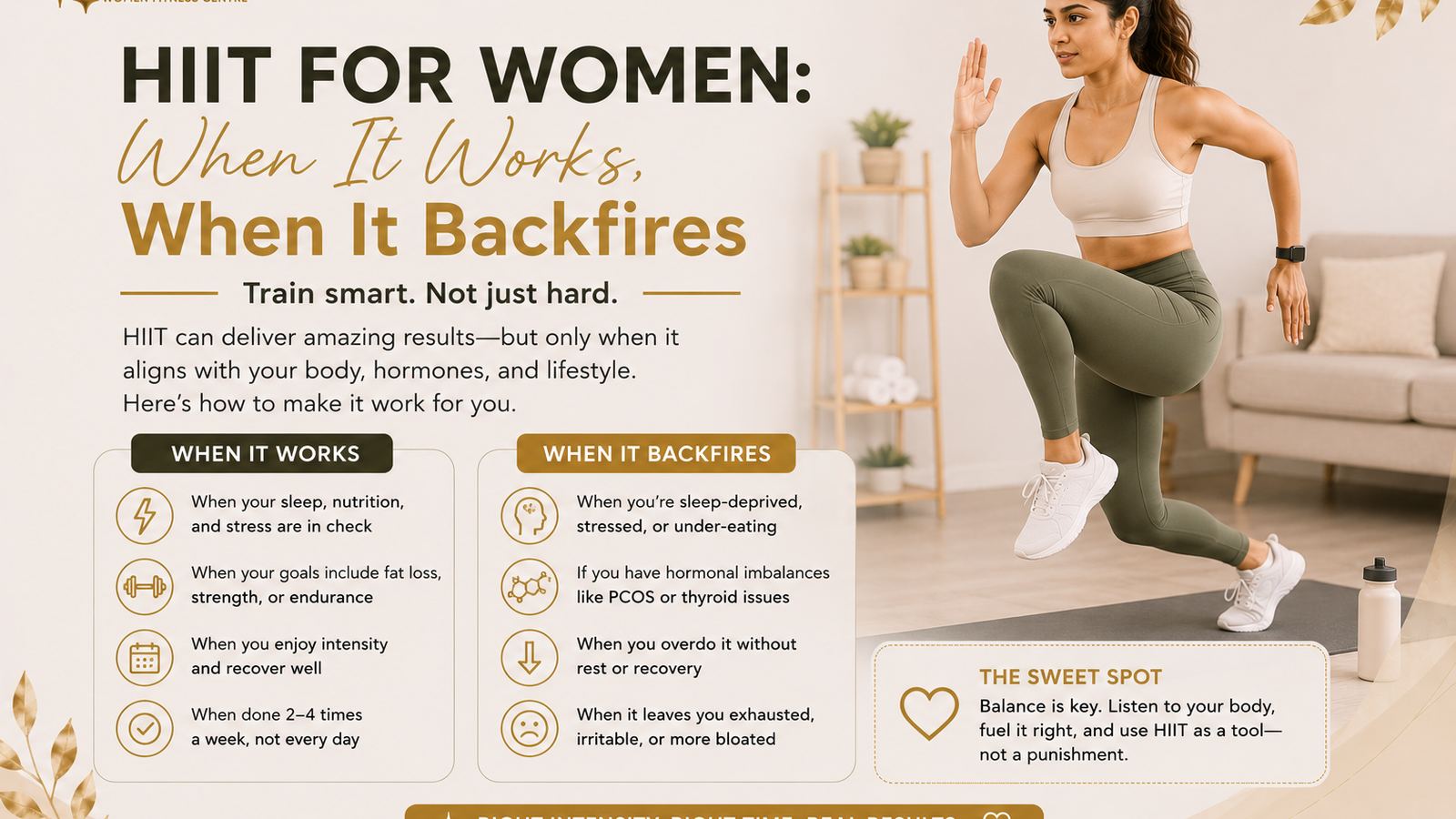
HIIT (high-intensity interval training) is everywhere — celebrity trainers, fitness apps, group classes selling “30-minute body transformation”. The marketing works because the underlying science is genuinely strong: short bursts of high-intensity work, separated by rest, produce real cardiovascular and metabolic benefits in less time than steady-state cardio.
What the marketing leaves out: women’s hormonal systems respond differently to HIIT than men’s, and daily-HIIT culture often backfires for women specifically. Here’s the honest version.
What HIIT actually is
True HIIT means: short bursts (15 seconds to 2 minutes) of all-out or near-all-out effort, alternated with rest or low-intensity recovery. Total workout time is usually 15–30 minutes including warm-up + cool-down.
What most gym classes labelled “HIIT” actually deliver is moderate-intensity interval training — harder than steady cardio, but not true HIIT. Both have benefits, but they’re different stimuli with different recovery demands.
The Tabata protocol (20 sec all-out + 10 sec rest × 8 rounds = 4 minutes of work) is true HIIT. A 45-minute “HIIT class” with continuous moderate effort is not — though the marketing label gets used loosely.
What real HIIT does (the genuine benefits)
The research is consistent. Done properly:
1. Improves insulin sensitivity — significantly, and faster than steady cardio. Even 1–2 short sessions a week move insulin markers measurably.
2. Raises VO2 max — cardiovascular fitness improves quickly with HIIT. 10–15% gains in 6–8 weeks is typical.
3. Promotes fat loss — particularly visceral (belly) fat. The EPOC (“afterburn”) effect adds modest extra calorie burn post-session.
4. Time-efficient — 20 minutes of HIIT can produce cardio adaptations comparable to 45–60 minutes of steady-state.
5. Preserves muscle better than long cardio — important for women in a calorie deficit.
For a busy woman wanting fast cardio adaptations + fat loss support, 1–2 HIIT sessions a week is genuinely useful. The argument isn’t whether HIIT works — it does. The argument is about dose.
Where it goes wrong for women
The hormonal reality the marketing ignores:
1. Women have a more sensitive cortisol response. Each HIIT session spikes cortisol significantly — that’s the stimulus. Done occasionally, the body adapts and cortisol returns to baseline. Done daily, cortisol stays chronically elevated.
For women, chronically elevated cortisol drives:
- Belly fat retention (paradoxically — the thing many women HIIT to lose)
- Insulin resistance worsening
- Cycle disruption (some women’s periods become irregular or stop with daily HIIT)
- Poor sleep
- Mood instability
- Eventually, plateau or weight gain despite the effort
2. Recovery demands are real. A proper HIIT session needs 48 hours of recovery for full nervous system + muscle restoration. Daily HIIT means you’re never fully recovered.
3. Cycle phase matters. HIIT in the follicular and ovulatory phases (when oestrogen supports performance) works well. HIIT in the luteal phase often worsens PMS and disrupts sleep. The same workout, different week, produces different outcomes.
4. RED-S risk. Relative Energy Deficiency in Sport — chronically under-eating combined with high training load. Affects active women disproportionately and leads to lost periods, low bone density, mood problems, and stalled progress. Daily HIIT is a major contributor.
The 6-week “HIIT every day” challenge that promises dramatic transformation: for some men it produces results. For most women, it produces a 4-week burst of progress followed by a 6-month plateau plus disrupted cycles.
The right HIIT dose for women
For most women in their 30s–50s aiming for general fitness + fat loss:
- 1–2 HIIT sessions a week, no more
- 15–25 minutes per session including warm-up and cool-down
- Schedule in follicular or ovulatory phase when possible
- 48+ hours between sessions (so not back-to-back days)
- Most of the weekly training as strength + walks + 1–2 moderate cardio sessions
A solid week:
- 3 strength sessions
- 1 HIIT session
- 2 moderate cardio / yoga sessions
- Daily walks
- 1 rest day
This produces better results — and is sustainable for years — than daily HIIT for 6 weeks then a 3-month gap.
HIIT formats that work for women
True HIIT (15–25 min)
Tabata (20 sec on, 10 sec off × 8 rounds × 3–4 exercises): ~16 minutes total. Brutal but brief.
30:30s: 30 seconds hard, 30 seconds rest, × 10 rounds. 10–15 minutes total. Easier to scale.
Sprint intervals: 8 × 20 second sprints + 60 second walks. ~10 minutes plus warm-up. Works on bike, treadmill, or running.
EMOM (Every Minute On the Minute): 10 burpees at the top of every minute for 10 minutes. Rest is whatever time you have left in that minute. Scales itself.
Moderate intervals (often labelled HIIT, less stress)
Steady-state with surges: 25 min brisk cycling with 5 × 30-sec hard surges. Less cortisol cost than true HIIT.
Circuit training with rest: 5 exercises × 45 sec on + 15 sec rest × 3 rounds. Standard “boot camp” format.
For most women, the moderate version 2× a week + a true HIIT session 1× a week is the sweet spot.
When to skip HIIT entirely
Some situations where HIIT isn’t the right tool right now:
- Pregnancy (any trimester) — moderate intensity is fine; HIIT is not
- First 12 weeks postpartum — and only after pelvic floor + core have been rebuilt
- Chronic sleep deprivation (under 6 hours regularly) — cortisol stack is too high
- Active high stress period — HIIT amplifies what’s already there
- Cycle disruption (missed periods, very irregular) — drop HIIT first; often resolves cycles
- First 4–6 weeks of returning to fitness after a long break — build base first
- History of overtraining or RED-S — work with a coach or sports physician
- PCOS with high stress / poor sleep — the cortisol-insulin loop makes daily HIIT counterproductive (see our PCOS post)
The “I love HIIT” question
Some women genuinely enjoy HIIT and find it sustainable at higher frequencies than the above. A few things to know:
- Listen to your body, not the program. If sleep, cycle, and mood are all holding, more frequency may work for you. If any of those break, dial back fast.
- Track sleep + cycle + mood weekly. These tell you what cortisol levels are doing before any lab can.
- Have a deload week every 4–6 weeks. Drop HIIT entirely for one week; do walks + strength + yoga. Cortisol resets; performance often jumps after.
- Eat enough. Under-eating + HIIT is the fastest way to hormonal disruption.
For competitive athletes or experienced trainers, the dosage can be higher. For most adult Indian women looking at HIIT as a fat-loss / fitness tool, 1–2 sessions a week wins.
What about CrossFit / F45 / Cult-style classes?
These are usually a mix of HIIT, strength, and metabolic conditioning. The same rules apply: 2–3 sessions a week is sustainable; 5–6 sessions a week eventually breaks most women.
If you genuinely love the format and feel great on it, fine. If you’ve noticed disrupted sleep, missed periods, mood swings, or chronic soreness — dial back to 2–3 sessions and add strength + walks on the other days.
For specific situations
HIIT for PCOS
Real evidence that HIIT improves insulin sensitivity specifically — useful for PCOS. But 1–2 sessions a week, not daily. Cortisol stack hits PCOS women harder. See our full PCOS protocol.
HIIT for perimenopause
Cortisol sensitivity is higher in perimenopause. Reduce HIIT frequency vs your 30s; emphasise strength + walks. See our perimenopause post.
HIIT for weight loss
It helps, but not more than strength training does for women specifically. Combine: 3 strength + 1 HIIT + walks. Don’t make HIIT the centrepiece. See our belly fat post for the full hierarchy.
What we do at Glow
Our Online Everyday Glow program includes 1–2 HIIT or interval sessions per week — strategically placed in the weekly rotation, with the strength + yoga + walk balance that prevents the HIIT-overload pattern. Coaches scale intensity based on what’s happening in your week — including your cycle.
The short version
- HIIT works — for fat loss, insulin sensitivity, VO2 max. 1–2 sessions a week is the sweet spot for most women.
- Daily HIIT backfires for women specifically — cortisol stack, cycle disruption, sleep, plateau.
- Schedule HIIT in follicular/ovulatory phase; back off in luteal week.
- Skip HIIT in pregnancy, first 12 weeks postpartum, when sleep is broken, or when periods are disrupted.
- True HIIT is 15–25 minutes including warm-up. A 45-minute “HIIT class” is usually moderate-intensity intervals — less stressful, less cardio adaptation.
- The right week: 3 strength + 1 HIIT + 2 moderate sessions + walks + 1 rest day.