
Workouts • 23/5/2026
Online Workouts for Working Women — The Realistic Guide
Four time windows that actually work for working women, what to do in each, and how to keep training when work weeks go sideways. Honest advice from a women-only fitness coach.
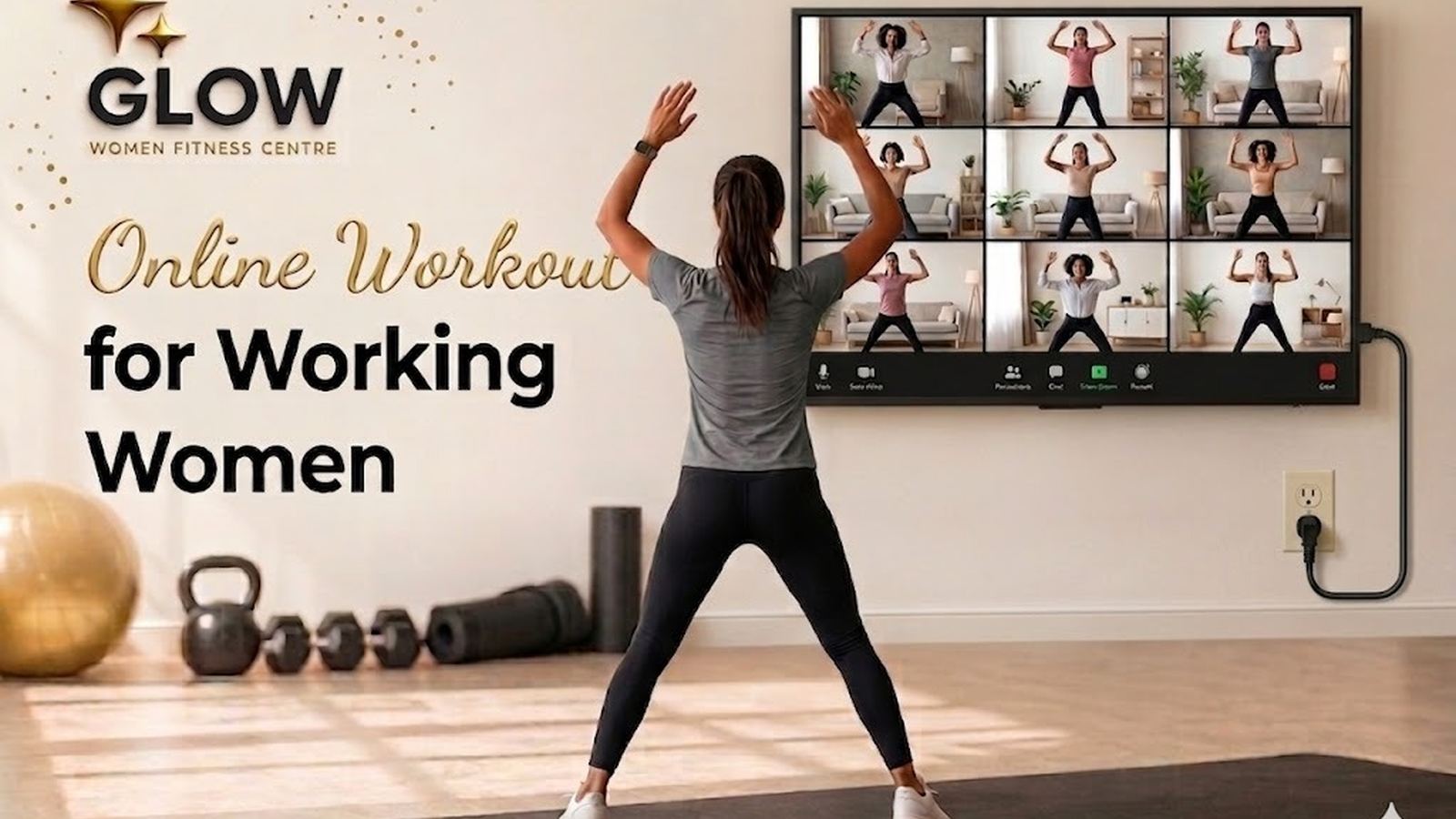
Most fitness advice for working women is written by people who don’t seem to work — or at least don’t have a manager Slacking them at 10 PM and a family member needing food by 7 AM.
This is the realistic version. We’ve coached hundreds of working women through our women-only studio and live online classes. Here’s what actually fits the day.
The honest math
A reasonable week of training for a working woman who wants results:
- 3–5 active sessions of 30–45 minutes (strength + cardio + yoga mix)
- 150 minutes of walking outside formal workouts (about 20 minutes a day)
- One rest day
That’s it. Not five gym days. Not 5 AM cold-plunge wellness theatre. Five sessions of 45 minutes, plus walks.
The total: roughly 3 hours/week of “workout” and 2.5 hours/week of walks = 5.5 hours. Less than most people spend on Instagram in two days.
The problem isn’t the time — it’s where in the day that time fits.
The four time windows that actually work
For working women, here are the four slots that have consistently worked for the members we coach. Most women settle into one or two of these.
Window 1: Before work (5:45–7:00 AM)
The objectively best window for most women, for one reason: once it’s done, the day cannot take it away.
A 6:00 AM live online class is brutal for the first two weeks and then becomes the most reliable hour of your week. No work fire derails it. No boss meeting overruns it. You wake up, mat down, 45 minutes, shower, coffee, day.
Make it work:
- Sleep 7+ hours by going to bed 8 hours before your wake time, not 7 (you’ll snooze the first one)
- Lay out workout clothes the night before — literally beside the bed
- Use the same coach and class slot every day; the routine carries the days you don’t feel like it
- Have breakfast ready to grab post-class (don’t add decision fatigue)
The first month is hard. By week 5 it’s so automatic you stop thinking about it.
Window 2: Lunch break (12:30–1:30 PM)
Underrated. Works especially well for women working from home or hybrid.
A 30-minute strength or yoga session, shower, eat, back to work. You return to the afternoon with significantly more energy than the post-lunch slump usually allows.
Make it work:
- Block the 1-hour calendar slot like a meeting — it’s an actual meeting with yourself
- Pre-prep lunch in the morning so you’re not cooking during the workout slot
- Skip lifts that need heavy showering (a yoga or mobility-focused day works better midweek)
Window 3: Right after work (6:00–7:30 PM)
The most common slot — and the slot most women bounce off. The problem isn’t the time, it’s the transition. You finish work, your brain wants to collapse, and the “I’ll start in 10 minutes” window opens — and 10 minutes becomes Netflix.
Make it work:
- Get into workout clothes the moment work ends, before you sit down. Physical cue to your brain that the next thing is movement, not screens.
- Have a fixed 6:30 PM live class on the schedule, not a “I’ll do a video sometime in the evening” plan.
- Eat a small carb-and-protein snack at 5:30 PM (banana + paneer, or chai + 2 idlis) — fuels the session.
- The first 5 minutes will feel awful. They always do. Show up anyway; energy returns by minute 10.
Window 4: After dinner (9:00–9:45 PM)
Last-resort slot. Works for some women — particularly young moms whose evenings are baby-bath-feed-sleep — and doesn’t work for others (insomnia, cortisol, partner schedules).
Make it work:
- Keep the intensity moderate; do strength or yoga, not HIIT (the cortisol spike trashes sleep)
- Class no later than 9:30 PM so you’re not heart-racing at 11
- Wind-down routine afterwards (shower, dim lights, no screens) for the next 30 minutes
If this is your only window, it’s still better than skipping. But Window 1 or 3 is almost always the better long-term option once you’ve found a rhythm.
The “I’m too tired” problem
Every working woman has heard “exercise gives you energy” so often it stops meaning anything. Here’s the mechanism, briefly, because understanding it makes the discipline easier:
When you’re tired from work, you’re cognitively tired, not physically tired. Your nervous system is fried; your muscles are fine. A 30-minute strength or yoga session shifts the nervous system out of the work loop, drops cortisol, raises endorphins, and within 90 minutes you’re more alert than before.
The exception: if you’re sleep-deprived (less than 6 hours for multiple nights), training intensity should drop. Walk, do gentle yoga, save the hard sessions for after you’ve slept. Hammering through fatigue isn’t badass, it’s how injuries and burnout happen.
Travel and irregular schedules
For women whose work has them on the road or whose hours shift week-to-week, the rules change:
- Live online classes win here, hands down. You can join from a hotel room. Try doing that with a gym membership.
- Have a bodyweight fallback routine — 20 minutes of squats, push-ups, lunges, planks, glute bridges — that you can do anywhere with no equipment. Run it on travel days.
- Lower the bar on travel weeks. Two short sessions a week is still consistency when your baseline is five. Don’t go to zero — that’s where comebacks become impossible.
- Walk more. Hotel mornings are surprisingly good for long walks before the day starts.
Building consistency despite chaotic weeks
The single biggest failure mode for working women’s fitness: a chaotic week breaks the routine, and the routine never restarts.
The fix is psychological, not logistical:
- Show up for the next class, even at 50%. Missed three classes last week? Don’t catch up — that’s how injuries happen and how guilt builds. Show up to the next scheduled class. That’s the whole rebuilding step.
- Track sessions, not weight or measurements. Print a calendar, tick the day you trained. Visible consistency builds discipline faster than scale numbers do.
- Have a 15-minute “minimum viable workout” — a session so short you can never argue against it. On bad days, do that. The momentum holds.
- Have a class scheduled at the same time every day — even days you don’t attend. The pattern stays alive.
The women in our online program who get long-term results aren’t the ones with perfect weeks. They’re the ones who never let a missed week become a missed month.
A realistic week for a working woman
If you’re starting from zero:
| Day | Slot | What |
|---|---|---|
| Mon | 11:00 AM or 6:00 PM | Strength A — full body, 60 min (live) |
| Tue | 30-min lunch walk | Active recovery |
| Wed | 11:00 AM or 6:00 PM | Yoga + mobility, 60 min (live) |
| Thu | Lunch walk + 10-min mobility | |
| Fri | 11:00 AM or 6:00 PM | Conditioning + HIIT, 60 min (live) |
| Sat | Walk or gentle stretch | Active recovery (no live class) |
| Sun | Walk 60 min outdoors | Rest |
Three live classes. Three walks. One rest day. Fits inside a working week without rearranging life.
The Glow approach for working women
Our Online Everyday Glow program runs Monday to Friday with two slots — 11am and 6pm IST — so most working women can find one that fits their day, and switch when work weeks shift.
The first class is free. Try one in the slot you think might work, and see whether the format holds.
The short version
- The realistic week: 3–5 sessions of 30–45 minutes, plus walks. Not more.
- The four windows that work: before work, lunch, right after work, after dinner. Pick one as primary.
- The “I’m too tired” problem is cognitive fatigue, not physical — training fixes it within 90 minutes.
- Travel weeks: drop intensity, keep frequency. Two short sessions is still consistency.
- Chaotic weeks happen. Show up for the next class, not a make-up week.