Workouts • 22/5/2026
Is Online Fitness Actually Effective for Women? An Honest Answer
The skepticism is fair. Here's what actually works in online fitness for women — and what's a waste of your time. From a women-only studio that runs both.
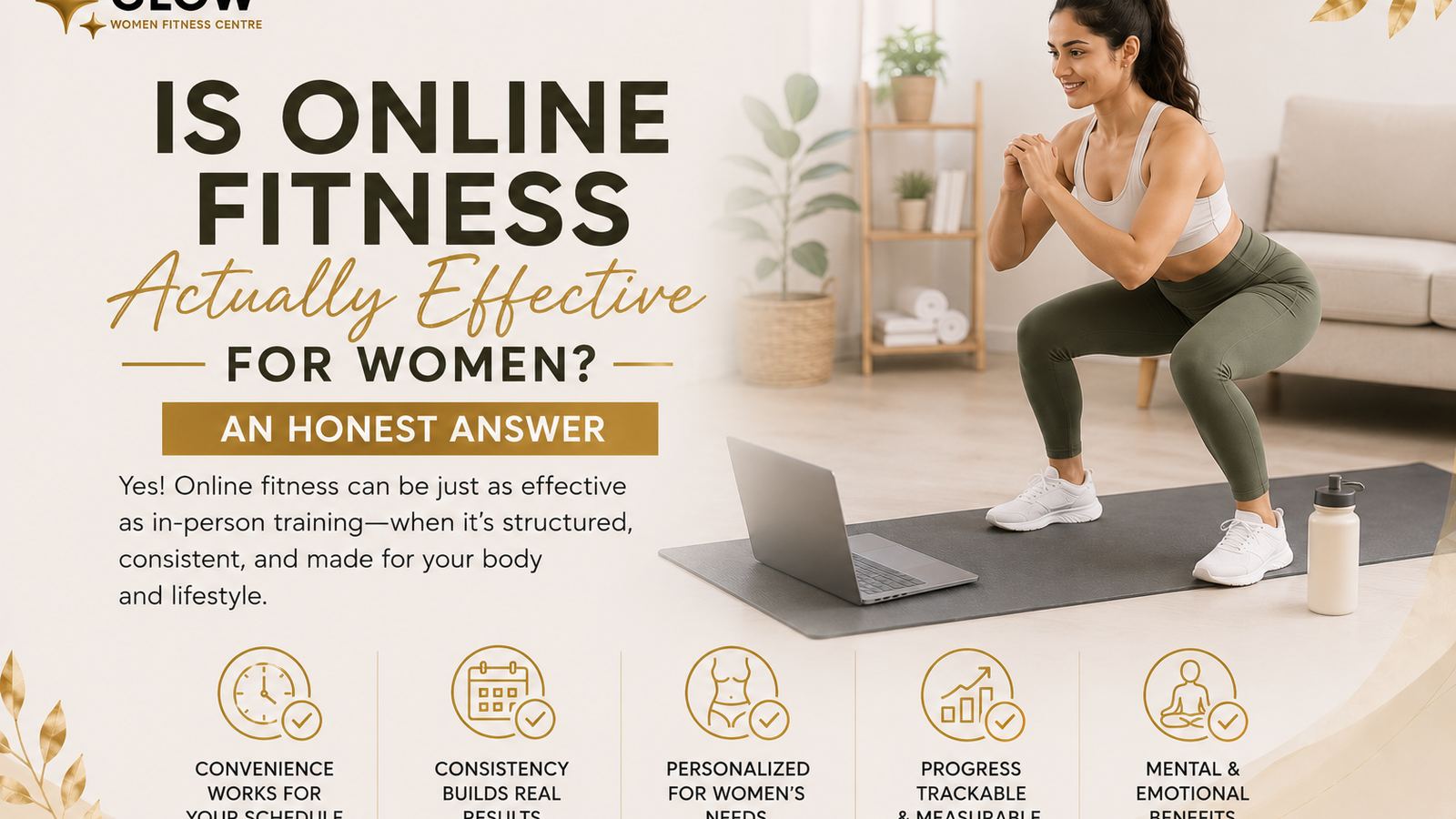
Three questions every woman asks before signing up for an online fitness program:
- Will I actually do it?
- Will it actually work?
- Is it as good as a real gym?
The honest answer to all three is “it depends on the format.” Online fitness done well rivals — and in some specific ways beats — an in-person gym. Online fitness done badly is a subscription you’ll regret in three weeks.
Here’s the distinction.
The myth: “Online fitness is for people who lack discipline”
This is the most common gym-owner pushback, and it’s wrong. The reason women drop off online programs isn’t lack of discipline — it’s that the format itself is broken.
The dominant model — buy a subscription, get access to a video library, “work out whenever” — was designed for the marketing funnel, not the human body. There’s a name for this in behavioural psychology: choice paralysis without accountability. Too many options, no scheduled commitment, no one waiting for you to show up. The same brain that easily commits to a 6 PM class with a coach freezes when asked to “pick a workout, any workout” at 6:47 PM after a long day.
The women who succeed with online fitness almost universally use one of two formats:
- Live, scheduled, small-group classes with a real coach (the closest thing to a physical class)
- 1:1 personal coaching with weekly accountability
Recorded libraries work for a narrow slice of already-highly-motivated women. For the rest — and that’s most of us — they’re expensive bookmarks.
What the research actually says
The 2021 Sports Medicine meta-analysis of remote vs in-person exercise programs is worth knowing: across 19 randomised controlled trials, remote-supervised programs produced equivalent strength, cardiovascular and body-composition outcomes compared to in-person programs — as long as a coach was actively involved.
Self-directed online programs (the library model) did much worse. The presence of a real coach was the single biggest predictor of adherence and results.
For women specifically, the American College of Sports Medicine and POGP guidelines for women’s fitness emphasise three things that online live classes are particularly well-suited to:
- Form feedback during strength training (your coach watches you on camera and corrects in real time)
- Pelvic floor and breath work (you actually need a private space — your living room is better than a gym floor for this)
- Cycle-aware programming (a coach who knows your cycle phase can adjust intensity; a video can’t)
What works in online fitness (and why)
If you’re evaluating an online program, look for these:
1. Live, not recorded
This is the non-negotiable. Live means the coach can see you. Form corrections happen. The community is real. The class starts whether you “feel like it” or not — and that scheduled commitment is why it works.
Recorded sessions feel cheaper to produce and feel infinite. Both are illusions: production-cheap recorded sessions usually look it (low engagement), and “infinite” content is exactly what creates the choice paralysis above. Schedule beats library, every time.
2. Small group, not stadium
A live class with 80 women on screen isn’t coaching — it’s a webinar. Look for class sizes under 25 where the coach knows your name and can call out form cues to you specifically. The best women-only online programs cap at 15.
3. A real coach, not a content creator
Watch the trainer for one session before committing. Are they cueing form in real time? Are they pausing the class to correct someone? Are they asking how your knee feels after the squat block? That’s coaching. If it’s a non-stop choreographed performance with no individual attention, it’s content.
4. Women-only matters more than you think
Mixed-gender online classes inherit the same dynamic as mixed-gender gyms — they’re often programmed for the average male body, the cues assume a male centre of mass, and the form corrections (or lack thereof) don’t account for things like wider pelvis biomechanics or pregnancy/post-pregnancy considerations.
For most Indian women, the cultural privacy factor matters too — being on camera, in your home, in workout clothes is easier in a women-only space.
5. The right program for women’s bodies
A serious women’s online program should include all four of: strength training, cardio, yoga/mobility, and pelvic-floor work. If a program only does cardio-and-stretching (“dance fitness”), it’s not training your body comprehensively. Women lose more muscle mass than men with age — strength training has to be in there.
What doesn’t work (and what to avoid)
- “Unlimited videos, work out anytime” — see above. Sign-up high, completion low.
- Calorie-burn-first marketing — anyone selling you on the calorie burn of a single workout is selling a fantasy. Sustainable fitness is consistent, mostly-easy movement that compounds. The flashy “burn 600 calories in 30 minutes” sessions are mostly hype.
- Programs without warm-ups and cool-downs — these are how injuries happen, especially at home where your space is small and you went straight from sitting.
- “Bikini body” or “shred” language — outdated framing, and a signal that the program is built around shame, not fitness. Skip.
- Programs that don’t talk about your cycle, pelvic floor, or post-pregnancy considerations — these are massive blind spots in mainstream fitness, and they show up in body and mood within months.
How it works specifically for women’s bodies
Three things online live classes are especially good at for women:
For working women — the format finally fits the day. No commute, no childcare scramble, no “I’ll go after the kids’ homework”. A 6 AM or 7 PM live slot, mat down, 45 minutes, done.
For new moms — being seen on camera by a coach who knows what you’ve just been through (and adapts the class accordingly) is a huge step up from “any gym”. You can also breastfeed mid-class without it being a thing. We’ve had mothers nurse a baby on camera during cool-down. It’s a feature.
For women dealing with PCOS, hormonal issues, or post-pregnancy recovery — these need adapted programming. A live coach can scale a class for a member who shouldn’t be jumping (T2 pregnancy, recent C-section, knee history), where a generic recorded workout cannot.
The Glow approach
We built Online Everyday Glow with one rule: it has to actually work. Live via Google Meet or Zoho Meet, Monday to Friday, women-only, small class, real coach. Strength + cardio + yoga + mobility on rotation. Form corrections happen on camera. Cycle-aware programming. Pelvic-floor work is included, not bolted on.
The first class is free. If the format works for you, you continue. If it doesn’t, there’s no pressure — we’d rather you go find what does.
The short version
- Online fitness works when it’s live, small, and coached. The library model doesn’t.
- For women, the right program covers strength + cardio + yoga + pelvic-floor work — and accounts for cycle, pregnancy and post-birth realities.
- The biggest predictor of success is scheduled commitment with a real coach — same as in-person.
- The biggest predictor of failure is “work out whenever” content libraries.
If you’ve tried online fitness before and bounced off, it probably wasn’t your discipline — it was the format. Try it live.
Want to skip the trial-and-error? Book a free live class with us →