
Workouts • 22/5/2026
What You Actually Need to Start an Online Workout at Home (Almost Nothing)
Skip the home-gym shopping list. The 4 things you need on Day 1, the ₹1,000 upgrade kit, and what to never buy. From a women-only fitness studio.
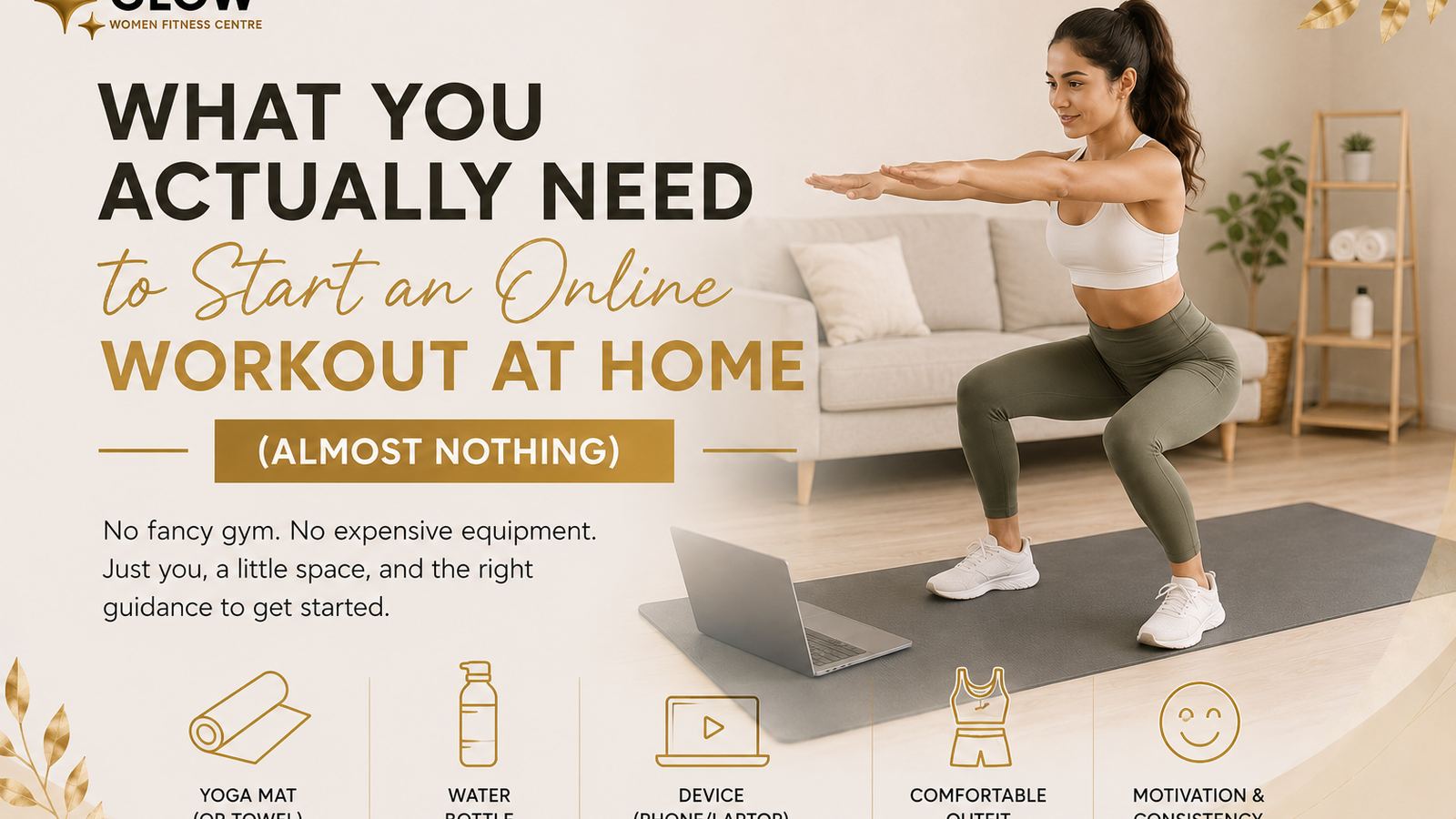
The single biggest reason women don’t start an online workout program isn’t motivation. It’s the imagined cost of “setting up a home gym.”
Forget that. You don’t need it.
After running a women-only fitness studio and live online classes for women across India, here’s the real list — what you genuinely need on Day 1, what to add later, and what to never buy.
Day 1 — what you need to start, today, for ₹0
If you have these four things, you can begin tomorrow morning:
- A flat space the size of a yoga mat — about 6 ft × 2 ft. A spare corner of the bedroom or hall is enough. You don’t need a “fitness room”.
- A wall — for wall push-ups, wall sits, single-leg balance.
- A sturdy chair — for tricep dips, step-ups, supported squats.
- A bottle of water — you’ll need more than you think.
That’s the entire starter kit. Bodyweight training will progress a beginner for 8–12 weeks before equipment starts to matter — which is roughly the time it takes for fitness to become a non-negotiable part of your week. By then you’ll know whether you want to invest.
Optional Day 1 add: a yoga mat (₹400–800 at any local sports shop), helpful but not required if your floor is clean and you don’t mind a thin towel under your knees.
Tier 1 upgrade — under ₹1,000
When bodyweight starts feeling too easy (usually weeks 4–8), add these two things:
A resistance band loop (₹200–500) The single most useful piece of equipment for women’s training. Use it for glute activation, banded squats, lateral walks, pulled-apart rows, assisted pull-ups eventually. Lasts years. Travels.
Look for a fabric loop band, not a thin rubber one — fabric doesn’t roll up your thighs, and lasts much longer.
A pair of light dumbbells (2 kg or 3 kg) (₹500–800 for the pair) Two kg is enough to add real load to lunges, rows, presses, glute bridges. Most women’s gym work for the first year happens with dumbbells under 8 kg.
Total kit so far: ~₹1,000. This will see you through 6–9 months of serious training.
Tier 2 — when you’re committed (under ₹3,000)
When you’re 4–6 months in and clearly continuing, the upgrade that matters:
Adjustable dumbbells (₹2,000–3,500 for a set with plates) Lets you progress from 4 kg to 10 kg as you get stronger. Saves the cost of buying multiple fixed-weight pairs over time.
If you have stairs in your house, those replace any need for a step platform.
That’s it. Total kit: ~₹3,500. For 95% of women, this is enough for years of training.
Tier 3 — only if you’re sure
The next steps are bigger investments (₹5,000–20,000+):
- A pull-up bar over a doorway (₹600–1,200) — useful if you want to build pulling strength seriously
- A kettlebell, 8 kg or 12 kg (₹1,500–2,500) — different stimulus, fun training tool
- A foam roller (₹600–1,200) — for recovery
- A weight bench (₹6,000–15,000) — only if you’re doing a structured strength program 4–5 days a week
- A treadmill (₹15,000–40,000) — only if outdoor walking isn’t possible
Most women never need Tier 3. The marketing pretends you do.
Space and floor — what actually matters
You need a flat, non-slippery surface. Marble floor with a yoga mat works. So does a tile floor. Carpeted rooms are harder for stable footing during anything single-leg.
Ceiling height matters more than floor space — you need clear overhead for arm raises and any kind of jumping. 8 ft is fine, 7 ft is tight, 6.5 ft is too low.
A wall to lean against, push against, or balance from — invaluable. Doesn’t matter which wall.
Tech setup — keep it simple
For a live online class via Google Meet or Zoho Meet, you need:
- A laptop, tablet or phone with a camera. A laptop is best (larger screen, more stable). A phone propped on a chair is fine.
- A stable internet connection (the basic broadband or 4G plan most homes have is plenty — you’re not on a video call back to a server in Singapore; your trainer is in India).
- Headphones or speakers. Earbuds work; a Bluetooth speaker is better for hands-free.
- Decent lighting. A ceiling light or window light so the coach can actually see you. Side-lit is best — front-on washes out your form.
That’s the entire tech stack.
What to never buy (it’s marketing)
These show up in every “home gym essentials” listicle. Skip them:
- Ab roller wheels — at best ineffective for women’s core training, at worst back-painful.
- Vibration plates — almost zero evidence they do anything useful.
- Waist trainers, sweat belts — actively harmful; they don’t burn fat (the marketing claim) and they restrict the diaphragmatic breathing that real core training needs.
- Detox teas / weight-loss shakes — wrong category, but they sell hard in fitness ads. Skip.
- The Bowflex-style “smart home gym” at ₹50,000+ — you almost certainly don’t need it. Adjustable dumbbells do 90% of what these do at 5% of the cost.
The fitness-tracker question
A smartwatch or step tracker (Mi Band, Fitbit, Apple Watch) is genuinely useful but not necessary. If you have one, it’ll help you spot real improvements (resting heart rate dropping over weeks is one of the best fitness indicators we have). If you don’t, walking around the room counting reps works fine. Don’t buy one as a precondition to starting.
The honest cost of starting
You can start a live online fitness program tomorrow for ₹0 of equipment. The class subscription is the only spend. Add ₹1,000 in equipment around month 2. Add ₹3,000 more around month 6 if you want to.
Compare that to a gym membership (₹15,000–30,000/year + commute + childcare + time), and “I don’t have the equipment” stops being a real reason to wait.
What we recommend our online members start with
For our Online Everyday Glow members, the actual Day 1 starter list we send:
- A yoga mat (if you can; not required)
- A pair of 2 kg dumbbells (₹500ish)
- One resistance band loop (₹300ish)
- A water bottle and a small towel
That’s ₹800 of total spend. Many members start with literally nothing for the first few weeks, and add equipment as the format proves itself.
The short version
You need almost nothing to start. A floor space, a wall, a chair, and a water bottle. Everything else is a future optimisation, not a precondition. Don’t let the imagined cost of a home gym be the reason you don’t begin.
Ready to start with the equipment you already have? Book a free online class →